Introduction

Artificial Intelligence is significantly transforming the way people work, learn, communicate, and solve everyday problems. Nowadays, AI can write articles, generate images according to your requirements, answer questions, create computer programs, and even help automate many repetitive business tasks.
However, one of the biggest advancements in Artificial Intelligence is AI Agents.
AI Agents are not like traditional chatbots that are only designed to answer specific types of questions. Instead, AI Agents are developed to understand the user’s needs, identify their goals, make decisions, plan multiple steps, use different tools, and complete tasks with minimal human involvement. They can perform these tasks automatically on their own.
Let’s take an example to understand this in a simple way. Suppose you ask an AI to write an email. A traditional chatbot will simply write the email for you. On the other hand, an AI Agent can collect the required information, write the email, schedule meetings, organize files, and even send follow-up messages automatically.
Because of all these capabilities, experts believe that AI Agents will become an important part of the future. Many industries are already exploring how AI Agents can improve productivity, reduce operational costs, and automate repetitive tasks. These industries include healthcare, businesses, educational institutions, software companies, and financial organizations.
In this article, we are going to explore what AI Agents are, how they work, their major features, benefits, real-world applications, and why experts believe AI Agents will play a huge role in shaping the future of Artificial Intelligence.
What Is an AI Agent?
An AI Agent is an intelligent software system that can understand your goals, make decisions, perform tasks, and interact with various tools or environments with minimal human involvement.
AI Agents are not like traditional AI systems or chatbots that only respond to a single prompt entered by the user. Instead, AI Agents are capable of planning multiple steps before completing a task.
For example, if you ask an AI Agent to plan a business trip, it can search for and compare hotels, create a travel schedule, book important appointments, organize documents, send confirmation emails, and perform all these tasks automatically without requiring you to instruct it at every step.
AI Agents use technologies such as Artificial Intelligence, Machine Learning, Natural Language Processing (NLP), Large Language Models (LLMs), and automation tools to understand your goals and perform tasks automatically. The primary objective of AI Agents is not just to respond to prompts but to complete tasks with a high level of efficiency and productivity while helping humans save time and effort.
How Does an AI Agent Work?
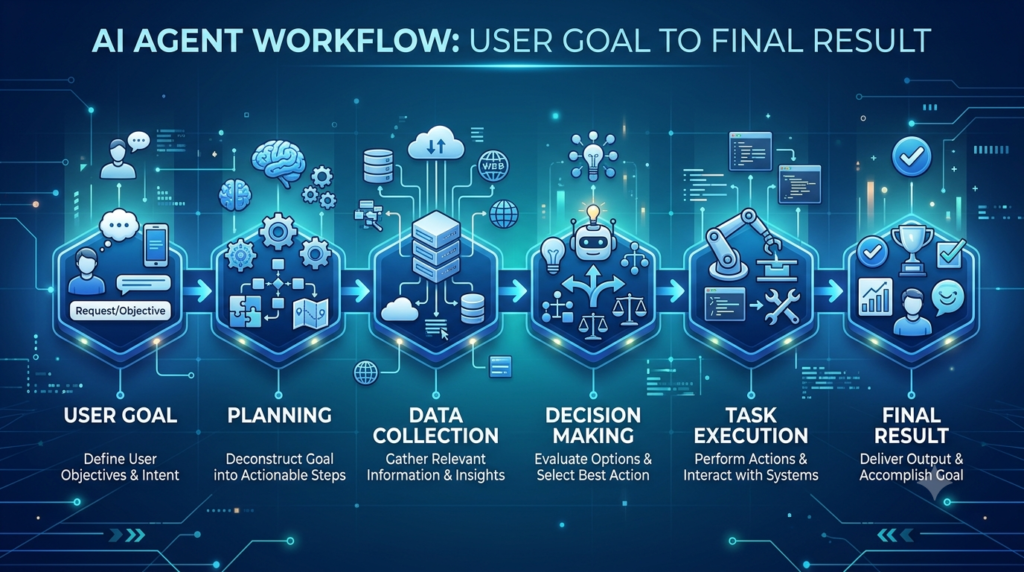
Although different AI Agents use different technologies, they generally follow a similar process.
Step 1: Understanding the Goal
In the first step, the AI Agent tries to understand what you want to achieve or what your main objective is.
For example:
“Plan a meeting in Delhi next week.”
With this instruction, the AI Agent understands your overall objective instead of focusing on only one instruction like traditional chatbots.
Step 2: Planning the Tasks
After understanding the goal, the AI Agent creates a plan.
For example, it may decide to:
- Search for flights
- Find hotels according to your preferences
- Schedule meetings
- Prepare travel reminders
Step 3: Collecting Information
In the third step, the AI Agent starts gathering information from different sources.
These sources may include:
- Search engines
- Business applications
- Cloud storage
- Productivity software
Step 4: Making Decisions
The AI Agent then analyzes all the collected information using Artificial Intelligence algorithms and decides the best action based on the user’s request.
Step 5: Completing the Task
In the final step, the AI Agent performs the required actions and provides the results to the user.
Instead of solving only one problem, it may continue working until the user’s main objective is completed. This is one of the biggest advantages of AI Agents.
Why Are AI Agents Becoming So Popular?
The main reason behind the growing popularity of AI Agents is that businesses are looking for smarter ways to automate their daily repetitive tasks and improve productivity.
Traditional AI systems usually perform only one specific task at a time, whereas AI Agents can understand the overall objective, adapt to new situations, and perform multiple tasks independently with very little human involvement.
Some of the major reasons behind the increasing popularity of AI Agents include:
- Rapid advancements in Artificial Intelligence
- Improvements in Large Language Models (LLMs)
- Growth of Cloud Computing
- Faster internet connectivity
- Business automation
- Increased business productivity
- Reduced operational costs
Many leading technology companies have already started investing billions of dollars in the research and development of AI Agents because they believe these systems will become an essential part of future workplaces.
Key Features of AI Agents
There are several important features that make AI Agents different from traditional AI software.
Goal-Oriented Decision Making
AI Agents focus on completing the user’s overall objective instead of simply responding to individual instructions.
Continuous Learning
Many AI Agents continuously improve over time by learning from previous conversations and interactions with users.
Problem Solving
AI Agents can understand the problems users are facing, analyze different possible solutions, evaluate them, and recommend the most suitable solution.
Natural Language Understanding
AI Agents can understand human language naturally, allowing users to communicate without using complicated commands.
Tool Integration
AI Agents can connect with various tools and applications such as calendars, email services, cloud storage, business software, and databases to complete tasks more efficiently.
Real-World Applications of AI Agents

AI Agents are already being used across many industries around the world.
Healthcare
AI Agents help doctors by analyzing medical records, scheduling appointments, monitoring patients, and assisting in disease diagnosis.
Business
AI Agents help businesses automate repetitive tasks such as customer support, managing emails, organizing meetings, generating reports, and improving productivity.
Education
Educational institutions can use AI Agents to personalize learning according to each student’s abilities. They also help answer students’ questions, recommend study materials, and track learning progress.
Finance
AI Agents can be used in financial institutions for fraud detection, customer support, risk analysis, and financial planning.
Smart Homes
AI Agents can be used in smart homes to control lights, security cameras, air conditioners, smart TVs, and other smart devices connected to the internet. They can manage these devices automatically, making everyday life more convenient.
Challenges and Risks of AI Agents
Although AI Agents are highly useful and are expected to transform Artificial Intelligence in the future, they still have several challenges that need to be addressed.
Privacy Concerns
AI Agents process a large amount of personal and confidential information. Because of this, privacy becomes an important concern, as unauthorized users may attempt to access sensitive data.
Security Risks
Proper security measures must be implemented in AI Agents. Otherwise, cybercriminals may attempt to misuse AI systems for cybercrime and other illegal activities.
High Development Costs
Building advanced AI Agents is quite expensive. It requires a significant investment in computing infrastructure, research, and skilled professionals to develop and maintain these systems.
Frequently Asked Questions (FAQ)
What is an AI Agent?
An AI Agent is an intelligent software system that can understand your goals, make decisions, perform tasks, and interact with various tools or environments with minimal human involvement.
Unlike traditional AI systems or chatbots that only respond to a single prompt entered by the user, AI Agents are capable of planning multiple steps before completing a task.
Where are AI Agents used?
AI Agents are commonly used in industries such as healthcare, education, finance, manufacturing, software development, customer support, business automation, and smart homes.
How are AI Agents different from chatbots?
Traditional chatbots are mainly designed to answer specific questions one at a time. AI Agents, on the other hand, can plan multiple tasks, make decisions, use different tools, and complete tasks automatically without requiring instructions for every step.
Final Thoughts
AI Agents are becoming one of the biggest advancements in Artificial Intelligence. Unlike traditional AI systems that perform only specific tasks, AI Agents are designed to understand goals, make decisions, use different tools, and complete multiple tasks with minimal human involvement.
As technologies such as Artificial Intelligence, Machine Learning, Cloud Computing, and Large Language Models continue to improve, AI Agents are expected to play a major role in transforming industries such as healthcare, education, finance, business, and software development.
Although challenges such as privacy, security, and development costs still exist, the future potential of AI Agents is enormous. Understanding this technology today will help students, professionals, businesses, and technology enthusiasts prepare for the next generation of intelligent automation.