
Introduction

Artificial Intelligence is already becoming a part of our daily life by making our everyday tasks very convenient. No matter what you are using, whether you are using AI to write content, search for navigation on Google Maps, get movie recommendations on Netflix, or use voice assistants like Siri and Alexa, Artificial Intelligence is the one working behind the scenes to make every task much easier.
However, today Artificial Intelligence is designed to perform only specific types of functions or tasks. It can answer your queries, recognize images, help in translating languages, or recommend products, but AI also has its limitations and cannot learn or think like human beings.
This is where Artificial General Intelligence (AGI) comes into the picture.
Experts believe that Artificial General Intelligence will play the most important role in the evolution of Artificial Intelligence. AGI is different from today’s Artificial Intelligence. It aims to understand almost every intellectual task that a human can do. It would be able to learn new skills, solve unfamiliar problems, make decisions in real time like humans, understand emotions, and adapt to different situations without requiring separate programming for every task.
Although Artificial General Intelligence has not been developed yet, it is currently under development by major technology companies that are investing billions of dollars in its research and development. Experts believe that AGI will eventually become a reality in the coming years and help transform industries like healthcare, education, manufacturing, scientific research, and transportation.
In this article, we are going to explore what Artificial General Intelligence (AGI) is, how it works, how it is different from today’s Artificial Intelligence, its major features, benefits, and challenges, and why experts believe that it could become one of the most revolutionary technologies of the future.
What Is Artificial General Intelligence (AGI)?
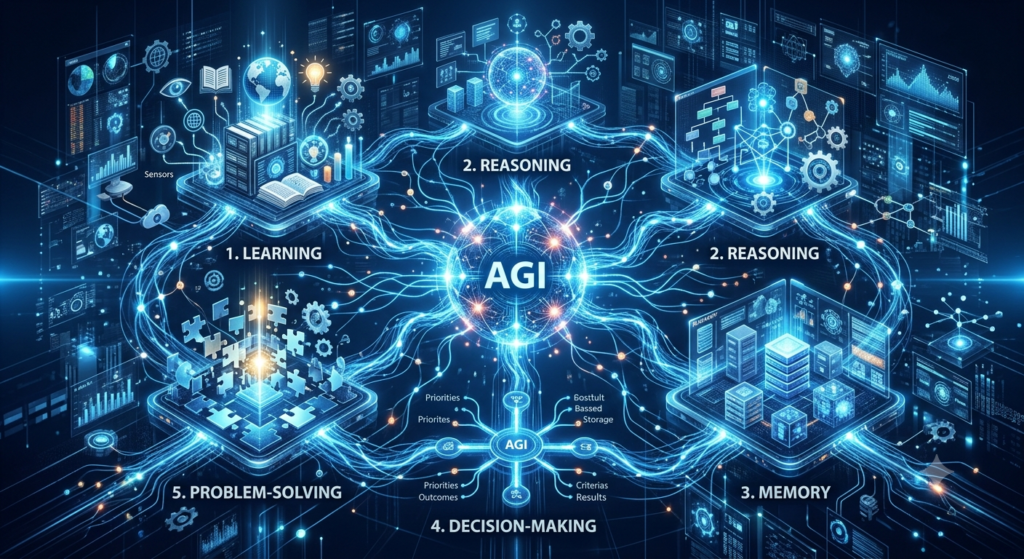
Artificial General Intelligence (AGI) is an advanced form of Artificial Intelligence that has the ability to understand, learn, and perform almost every intellectual task that humans can do in their daily lives.
Unlike today’s Artificial Intelligence systems, which are developed to perform only specific types of tasks, AGI is designed with the ability to learn, solve problems, learn from experience, and adapt to future situations without requiring additional programming for every specific task.
Let’s take an example to understand it more clearly.
Today’s AI can generate high-quality images and answer your questions in an understandable way, but it cannot become a doctor, engineer, scientist, and teacher at the same time. Whereas an Artificial General Intelligence system could learn all these skills just like a human learns throughout life.
The main objective behind the development of AGI is to create machines that are capable of matching human-level intelligence across various fields instead of being limited to performing only specific types of tasks.
Why Is AGI Becoming So Popular?
Artificial General Intelligence has become one of the most discussed topics in the technology industry over the past several years. The main reason behind this is the rapid growth of Artificial Intelligence, which has made machines much smarter and more intelligent over time.
As AI continues to grow, researchers have started working on developing systems that can think and learn like humans.
Some of the major reasons behind the increasing popularity of AGI include:
- Faster improvements and advancements in Artificial Intelligence
- Advancements in Machine Learning
- Availability of massive amounts of data
- Faster computer processors
- Growth of Cloud Computing
- Better robotics technology
- Increased investment from large technology companies
Many professional experts believe that Artificial General Intelligence could become one of the biggest technological revolutions of the 21st century.
How Is AGI Different from Artificial Intelligence?
Many people think that Artificial Intelligence and Artificial General Intelligence are the same thing, but the difference between them is quite significant.
Today’s Artificial Intelligence is also known as Narrow AI because it is designed to perform only specific types of tasks.
For example:
- ChatGPT can generate text.
- Google Translate can translate languages.
- Netflix recommends movies.
- Face Recognition helps unlock smartphones.
- AI image generators help create images.
Although all these AI systems perform their specific tasks very well, they are unable to perform tasks beyond their programming.
Artificial General Intelligence is completely different.
AGI has the ability to learn new skills, understand unfamiliar problems, solve them in real time like humans, and improve its knowledge over time through experience without needing separate programming for every task.
Instead of performing only one task, AGI can perform multiple tasks just like humans.
How Does Artificial General Intelligence Work?
Although AGI has not been developed yet, researchers believe that it will combine several advanced technologies that will help it reach human-level intelligence.
Some of the major technologies expected to power Artificial General Intelligence include:
Machine Learning
Machine Learning helps computers understand and analyze data instead of simply following fixed instructions.
Deep Learning
Deep Learning works similarly to the human brain. It uses artificial neural networks that help recognize patterns and make decisions quickly.
Natural Language Processing (NLP)
Natural Language Processing helps machines understand, process, and communicate using human language.
Computer Vision
Computer Vision helps machines recognize objects, faces, videos, and their surroundings using cameras and images.
Robotics
By controlling robots and automated systems, Robotics helps Artificial General Intelligence interact with the physical world.
Together, all these technologies may help Artificial General Intelligence understand the world more naturally and make intelligent decisions in real-time situations.
Key Features of Artificial General Intelligence (AGI)
Artificial General Intelligence is expected to be developed with several unique features that will make it very different from today’s Artificial Intelligence.
Some of its major features include:
- Human-level reasoning ability
- Continuous learning through experience
- Ability to solve unfamiliar problems
- Improved decision-making capabilities
- Ability to adapt to changing situations
- Natural communication with humans
- Ability to perform multiple tasks without restraining
These features are expected to make Artificial General Intelligence one of the most exciting technological developments currently under research and development.
Benefits of Artificial General Intelligence (AGI)
Artificial General Intelligence has the capability and the ability to transform almost every industry by performing multiple tasks, just like the human brain can do. It is not like today’s Artificial Intelligence, which only performs a specific task at a given time. Artificial General Intelligence is capable of understanding, learning, and solving different types of problems without requiring separate programming for every task.
Some of the major benefits that Artificial General Intelligence can provide are:
1. Faster Problem Solving
Artificial General Intelligence can help in analyzing huge amounts of data and provide solutions to complex problems in real time, even faster than humans. This will eventually help engineers, businesses, governments, and scientists make better decisions.
2. Improved Healthcare
AGI can assist doctors in diagnosing diseases, analyzing medical records, discovering new medicines, and providing personalized treatment plans for every patient by analyzing their medical history.
3. Better Education
AGI can help make education more personalized by providing learning according to every student’s learning speed, strengths, and weaknesses, eventually improving overall learning outcomes.
4. Increased Productivity
This will be very helpful for businesses because many businesses perform repetitive tasks throughout the year. By adopting AGI, businesses can automate repetitive tasks while allowing employees to focus on more important, creative, and strategic work. This will help increase efficiency across many industries.
5. Scientific Research
Artificial General Intelligence may help increase the speed of discoveries in medicine, physics, chemistry, climate science, and space exploration by processing huge amounts of data in a short span of time. This will help improve efficiency and reduce the wastage of time.
Challenges and Risks of AGI
Although we know that AGI can bring many possibilities in the future, it also comes with several challenges that we have to face.
Job Displacement
This is one of the biggest concerns among people. Many believe that AGI may automate jobs that are currently performed by humans and eventually replace some of them. Although new jobs may also be created, workers may need to learn new skills to adapt to future job requirements.
Ethical Concerns
Even if AGI becomes capable of making important decisions in real time, questions will definitely arise regarding responsibility, fairness, transparency, and accountability.
Security Risks
Powerful Artificial General Intelligence systems may become targets for cybercriminals if proper security measures are not taken or implemented carefully.
Misuse of Technology
AGI is like any other powerful technology, and there is a possibility that it could be misused for cybercrime, misinformation, surveillance, or autonomous weapons if strict regulations and security measures are not implemented.
High Development Costs
Developing Artificial General Intelligence is not easy, as it requires a huge amount of computing power, advanced research, and highly skilled professionals.
Frequently Asked Questions (FAQ)
What is Artificial General Intelligence (AGI)?
Artificial General Intelligence is an advanced form of Artificial Intelligence that has the ability to understand, learn, and perform almost every intellectual task that humans can do.
Unlike today’s Artificial Intelligence systems, which are developed to perform only specific types of tasks, AGI is designed with the ability to learn, solve problems, learn from experience, and adapt to future situations without requiring additional programming for every specific task.
Why is AGI important?
Artificial General Intelligence has the potential to improve industries like healthcare, education, scientific research, business productivity, and transportation by solving complex problems more efficiently with human-level intelligence.
Will AGI replace humans?
No, that’s not completely true. Most experts believe that AGI will help automate many tasks while also creating new job opportunities. It is not expected to completely replace humans. Instead, it will assist people in many industries and help improve productivity and efficiency.
Is AGI available today?
No. Artificial General Intelligence is not available today. It is still under research and development, and experts believe it may become a reality in the coming years. Current AI systems are examples of Artificial Narrow Intelligence (ANI).
Final Thoughts
Artificial General Intelligence (AGI) is expected to become one of the most ambitious developments in modern technology. While today’s AI systems are already transforming many industries, AGI aims to take intelligence to the next level by performing multiple tasks just like the human brain.
AGI aims to match human intelligence and solve problems in a human-like way. Although true AGI is still under research and development, major technology companies are investing billions of dollars into its development because of its huge potential.
Its future applications in industries like healthcare, manufacturing, finance, transportation, and scientific research make it one of the most exciting technologies of the future.
Internal Linking Suggestions
If you’d like to learn about the biggest innovations shaping the future, read our article Top 10 Technologies That Will Change the World by 2030.
To understand the differences between today’s AI and future AI systems, check out Top 10 Free AI Tools That Can Save You Hours Every Week in 2026.
If you’re interested in comparing popular AI assistants, read ChatGPT vs Google Gemini: Which AI Assistant Is Better in 2026?
To learn how future internet infrastructure will support intelligent systems, explore How 6G Technology Will Change the Internet Forever.
If you’re curious about the next generation of computing, don’t miss How Quantum Computing Could Change Everyday Life by 2035.