Introduction
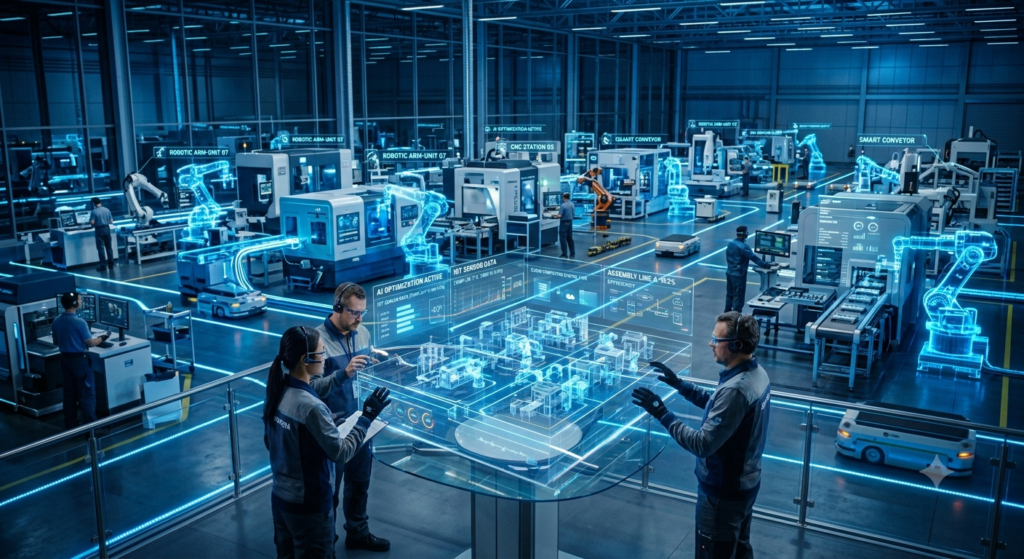
Nowadays, businesses are constantly looking for smarter ways to solve problems, improve efficiency, reduce costs, and make better decisions in their daily operations in real time. As technology is evolving at a very rapid rate, Digital Twin Technology is becoming one of the most exciting technologies helping businesses achieve these goals.
Today, many industries are using Digital Twin Technology to monitor equipment, predict problems before they occur, and improve the overall performance of their businesses. These industries include manufacturing, healthcare, construction, automotive, and smart cities. The reason why Digital Twin Technology is able to do this is because it creates a virtual copy of real-world objects, machines, processes, or even an entire system.
Now, imagine you have a virtual version of a factory machine that updates itself in real time whenever the actual machine changes. With the help of this, engineers can monitor its performance, detect possible failures before they become major problems, and even test different solutions without touching the real machine. This not only saves time but also helps improve productivity while reducing maintenance costs.
Digital Twin Technology is now becoming one of the most important innovations of the Digital Transformation era. Experts believe that as technologies like Artificial Intelligence (AI), the Internet of Things (IoT), Cloud Computing, and 5G continue to develop, Digital Twin Technology will become even more powerful in the coming years.
In this article, we are going to explore what Digital Twin Technology is, how it works, its major components, different types, and why it is becoming one of the most important technologies across various industries.
What Is Digital Twin Technology?
Digital Twin Technology is a technology that helps in creating a virtual representation of physical objects, machines, or processes. This is possible because the virtual model continuously receives real-time data from the physical object through sensors and connected devices placed on it.
This is not like a normal computer simulation. In fact, a Digital Twin continuously updates itself automatically based on real-world data. This helps engineers, businesses, and organizations monitor overall performance, identify problems, predict possible failures, and improve operations without affecting the actual physical object.
Digital Twin Technology can represent many different things, such as manufacturing machines, cars, airplanes, buildings, hospitals, smart cities, power plants, and even entire factories.
The main objective of Digital Twin Technology is to understand how a physical object performs by using its virtual copy.
How Does Digital Twin Technology Work?
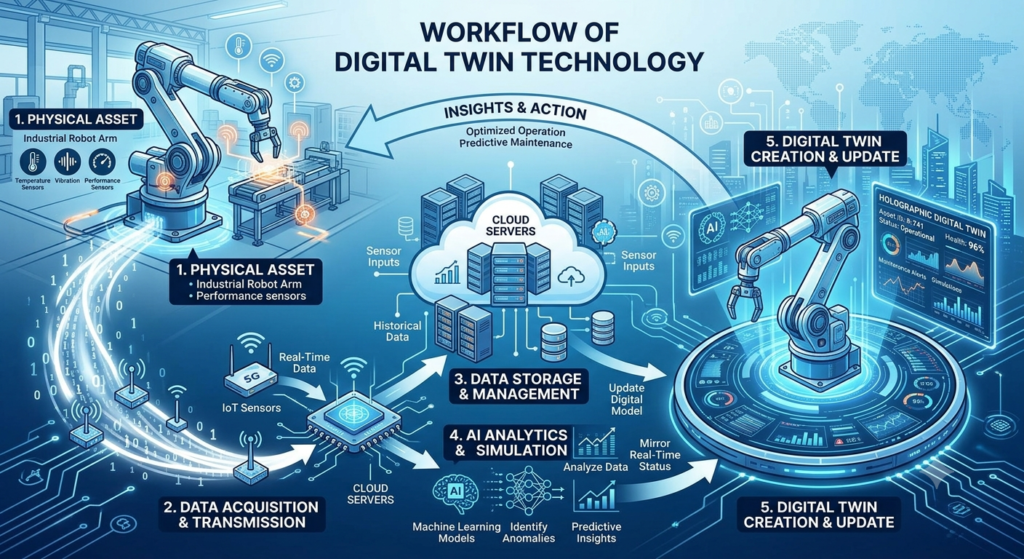
Digital Twin Technology is actually a combination of several modern technologies that help create a virtual model of a real-world physical object.
Let’s understand the process step by step.
Step 1: Data Collection
The real-world physical object is equipped with sensors that continuously collect information in real time. These sensors help monitor:
- Temperature
- Pressure
- Speed
- Vibration
- Location
- Humidity
Step 2: Data Transmission
Once the sensors have collected the information, the data is transmitted through communication technologies such as:
- 5G
- Wi-Fi
- Bluetooth
- Ethernet
After that, the collected information is sent to cloud servers or edge computing systems for processing.
Step 3: Data Processing
The received data is further analyzed using technologies like:
- Artificial Intelligence (AI)
- Machine Learning
- Big Data Analytics
- Cloud Computing
These technologies help identify patterns, detect abnormalities, and predict future performance.
Step 4: Digital Twin Updates
In this process, the analyzed information automatically updates the virtual model in real time. Whenever the physical object changes, the Digital Twin also updates itself automatically. This helps engineers monitor the condition of machines or objects without physically inspecting them.
Step 5: Decision Making
After the data has been analyzed, businesses can:
- Predict possible failures
- Schedule maintenance
- Improve efficiency
- Reduce costs
- Make better operational decisions based on the analyzed data
Why Is Digital Twin Technology Becoming So Popular?
Nowadays, industries generate massive amounts of data during their daily operations. Factories, hospitals, vehicles, power plants, and smart cities all rely on connected devices that continuously generate valuable information in real time.
Today, organizations want to improve performance, reduce costs, and make better decisions instead of simply storing huge amounts of data.
Some of the major reasons behind the growing popularity of Digital Twin Technology include:
- Real-time monitoring
- Predictive maintenance
- Improved operational efficiency
- Reduced maintenance costs
- Better decision-making
- Improved product quality
- Increased productivity
- Better resource management
Many leading technology companies are already investing heavily in Digital Twin Technology because it helps them identify problems before they become expensive failures that can interrupt business operations.
Key Components of a Digital Twin
There are several important components of Digital Twin Technology that help it achieve its objective.
1. Physical Object
These are the real-world objects being monitored. Examples include:
- Machines
- Manufacturing equipment
- Buildings
2. Sensors
Sensors continuously collect information from physical objects in real time. Examples include:
- Temperature sensors
- Pressure sensors
- Motion sensors
- Humidity sensors
3. Connectivity
The collected information is transmitted through communication networks such as:
- Wi-Fi
- 5G
- Bluetooth
- Internet
4. Cloud Computing
Cloud platforms handle the storage of data and process the collected information. This helps make the information accessible from anywhere around the world.
5. Artificial Intelligence (AI)
Artificial Intelligence handles the task of analyzing the information to identify patterns in the data, predict possible future failures, and recommend improvements.
Real-World Applications of Digital Twin Technology
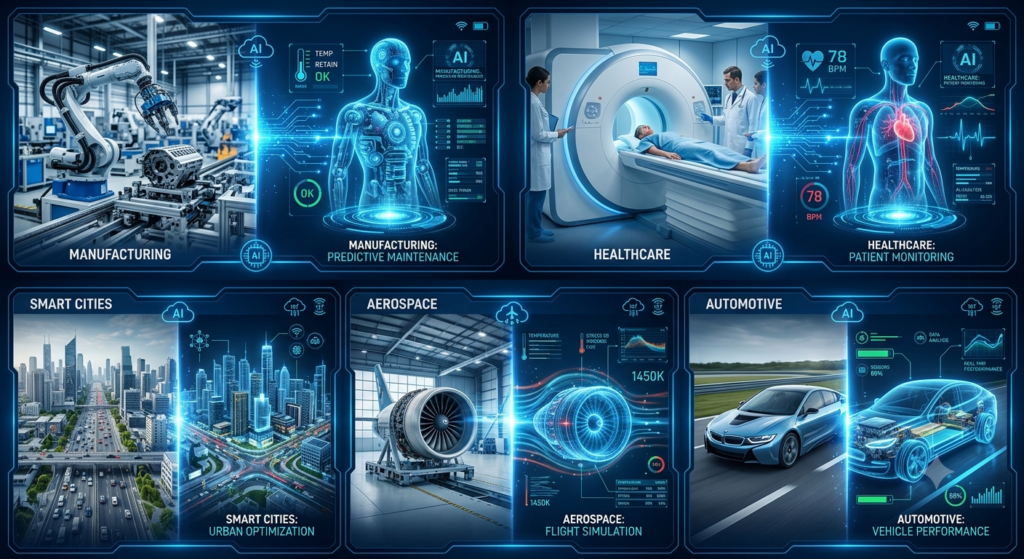
Digital Twin Technology is already transforming many industries around the world.
Manufacturing
Manufacturing industries use Digital Twin Technology to monitor machines, improve production, and reduce equipment failures.
Applications include:
- Predictive maintenance
- Production monitoring
- Quality control
- Industrial automation
Healthcare
Healthcare organizations use this technology to improve patient care and hospital operations.
Applications include:
- Patient monitoring
- Medical equipment management
- Hospital planning
- Personalized treatment for patients
Smart Cities
Many modern cities are using Digital Twin Technology to improve public services.
Applications include:
- Traffic management
- Energy management
- Water supply monitoring
- Waste management
- Public safety
Aerospace
Aircraft manufacturers use Digital Twin Technology to monitor the performance of aircraft throughout their lifecycle.
Applications include:
- Aircraft maintenance
- Engine monitoring
- Flight performance analysis
- Safety improvements
Automotive Industry
Car manufacturers use Digital Twin Technology to help design, test, and improve vehicles before production begins.
Applications include:
- Vehicle testing
- Electric vehicle development
- Predictive maintenance
- Performance optimization
Frequently Asked Questions (FAQ)
What is Digital Twin Technology?
Digital Twin Technology is a technology that helps create a virtual representation of physical objects, machines, or processes. This is possible because the virtual model continuously receives real-time data from physical objects through sensors and connected devices placed on them.
Which industries use Digital Twin Technology?
Many industries use Digital Twin Technology. Some examples include:
- Manufacturing
- Healthcare
- Aerospace
- Automotive
- Energy
- Construction
- Logistics
Does Digital Twin Technology use Artificial Intelligence?
Yes. Digital Twin Technology uses Artificial Intelligence (AI) and Machine Learning to analyze data, predict possible failures, and improve the decision-making process.
🔗 Internal Article Link Suggestions
- What Is Edge Computing? Benefits, Uses & Future Applications
- What Is Cloud Computing? Types, Benefits & Real-World Uses
- What Is the Internet of Things (IoT)? A Beginner’s Guide
- What Is Artificial General Intelligence (AGI)?
- Top 10 Technologies That Will Change the World by 2030
- What Is Quantum Internet? How the Future of Secure Communication Works